With the busyness of life, I only just managed to see the Beatriz Gonzalez retrospective at the Barbican before it closed on 10th May. It happened to be the same day as the local council elections, and I was going to head off to the polling station straight after the exhibition. It is safe to say that it felt like a lot was hanging on these elections, the importance of voting had never felt so acute, so polarising. Getting the train up to London, I saw countless posts online pleading for people to get out and vote, to think carefully about what they wanted for their communities, whilst also looking out the window seeing St George’s flags scarring the sky, an unsettling expression of patriotism.
Gonzalez too was no stranger to the weight of politics, living through decades of instability, corruption and bloodshed in Columbia from the 1940s, and the consequences it had on ordinary people’s lives every day. This exhibition traces Gonzalez’s lifelong fascination with how images are circulated and reproduced, repurposing them herself to question ideas of taste, power structures and violence.
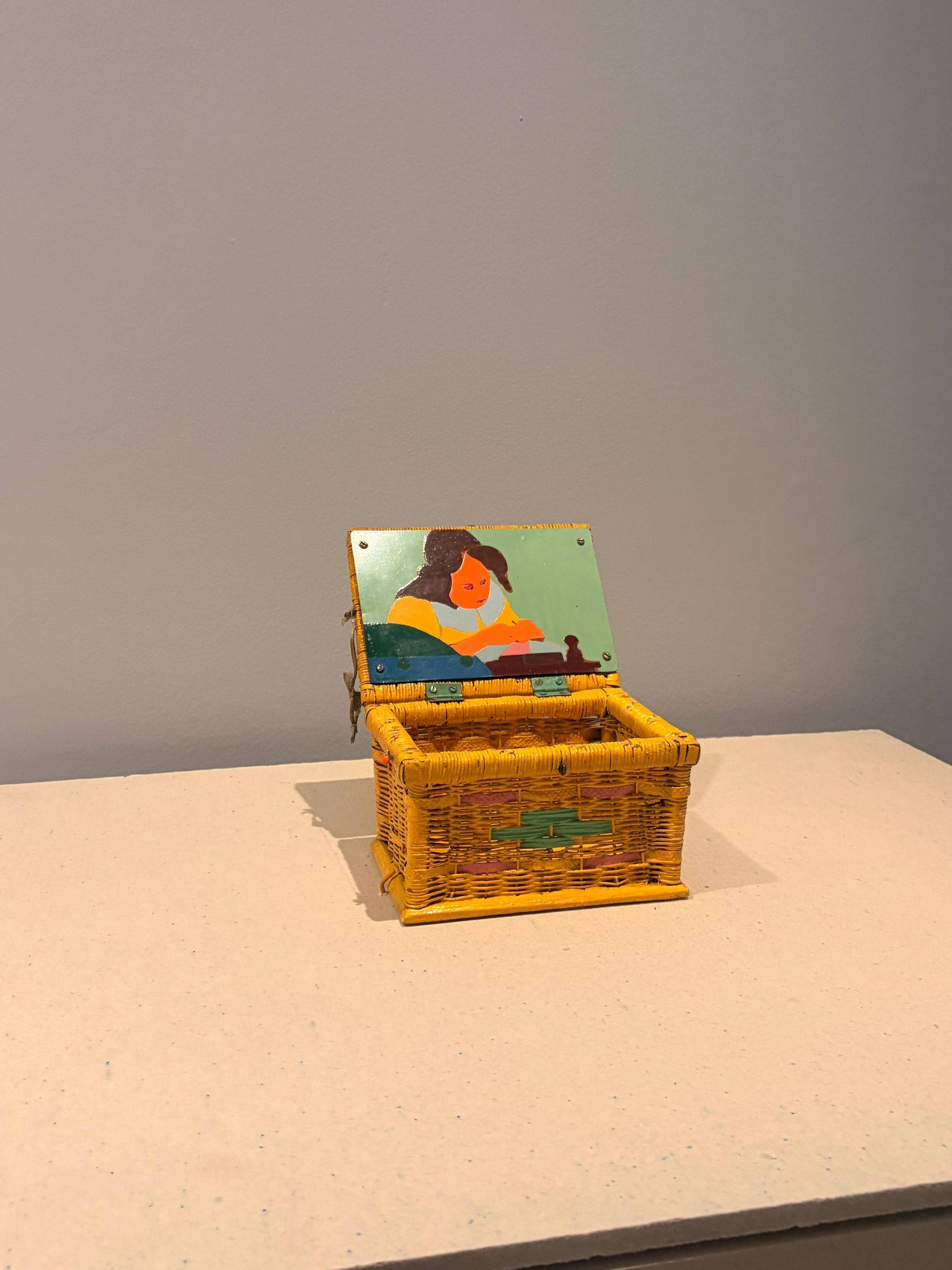
In Columbia, Gonzalez is known as “la maestra” (the teacher). However, her practice was first learnt by looking at other artists. The exhibition opens with a series of works from 1964 in which Gonzalez examines Velazquez and Vermeer. Even at the beginning of her career, she was already using lurid colours to block out her compositions with the confidence of an established painter. It is an understatement to describe these works as just copies; rather, famous paintings are pulled apart, distilled and flattened to their purest form. Then, they are humorously installed onto banal objects - Vermeer’s The Lacemaker is found on a woven picnic basket, for example. Gonzalez transforms art historical traditions into her own visual language, which projects loudly across the exhibition.
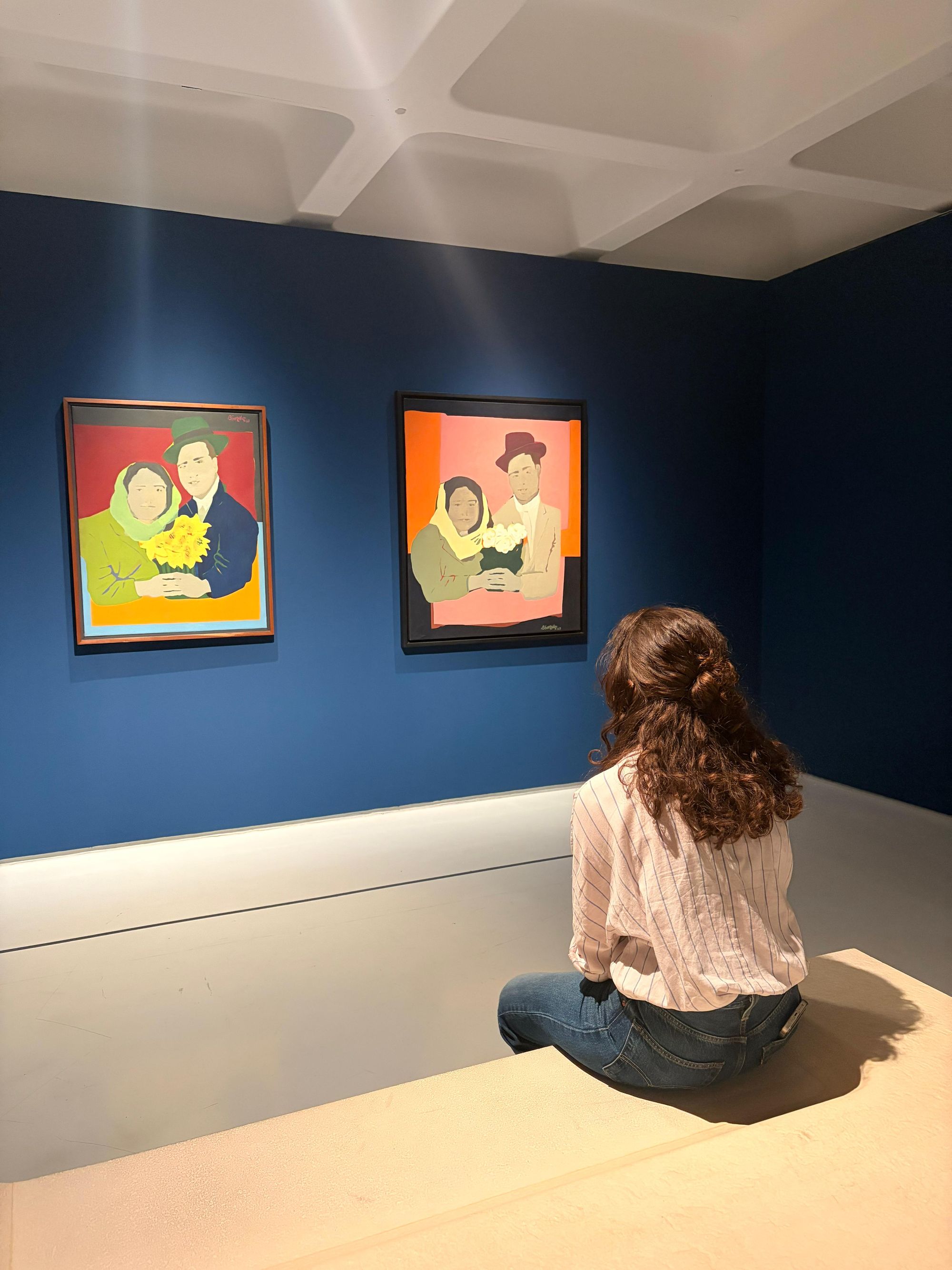
Perhaps we can also call Gonzalez “the investigator.” Along the landings between sections of the exhibition are vitrines filled with cut-outs from newspapers and magazines Gonzalez collected over her lifetime. It is like you are looking at a crime scene board, scattered with images of victims, shocking headlines and gruesome details, and the artist is trying to decipher these often poorly printed sources. This is realised in one of Gonzalez’s most famous works, The Sisga Suicides I, II and III from 1965. Following the joint suicide of a young couple in Bogota, she was inspired by the low quality portrait that circulated in the news, how their facial features were “deformed by the discrepancy.” Although the paintings could be considered rudimentary, they capture the flattening effect of the original image - the couple’s tight-lipped smiles, their fused-together hands and creaseless clothes - with remarkable precision. However, this is not just an exploration of the formal elements of art like line, shape and colour. It is an inquiry into how mass media images are reproduced as easily as they are then forgotten. Gonzalez just asks us to look for a little longer, commemorating the real people and stories captured for one day’s worth of news.
A series of work which I was less familiar with that captures this grace given to the deceased
was Murdered Woman at Lodging, (1985). Gonzalez takes as her source a photo from a newspaper of a woman lying on a floral bedspread, an arrow pointing to where she had been stabbed in the neck and a line covering her breasts. The image is sensitively replicated onto actual bedspreads found in lots of Columbian homes, but the markings made by the newspaper editor are removed. The original image is transformed from an uncomplimentary crime scene photo of femicide to a tender memorial. The woman was never identified, and yet Gonzalez treats her with dignity in her anonymity, figuratively laying her on a bed of flowers. The use of found objects as her canvases highlights the prevalence of violence in Columbia, particularly against women, as a brutal every day occurrence.
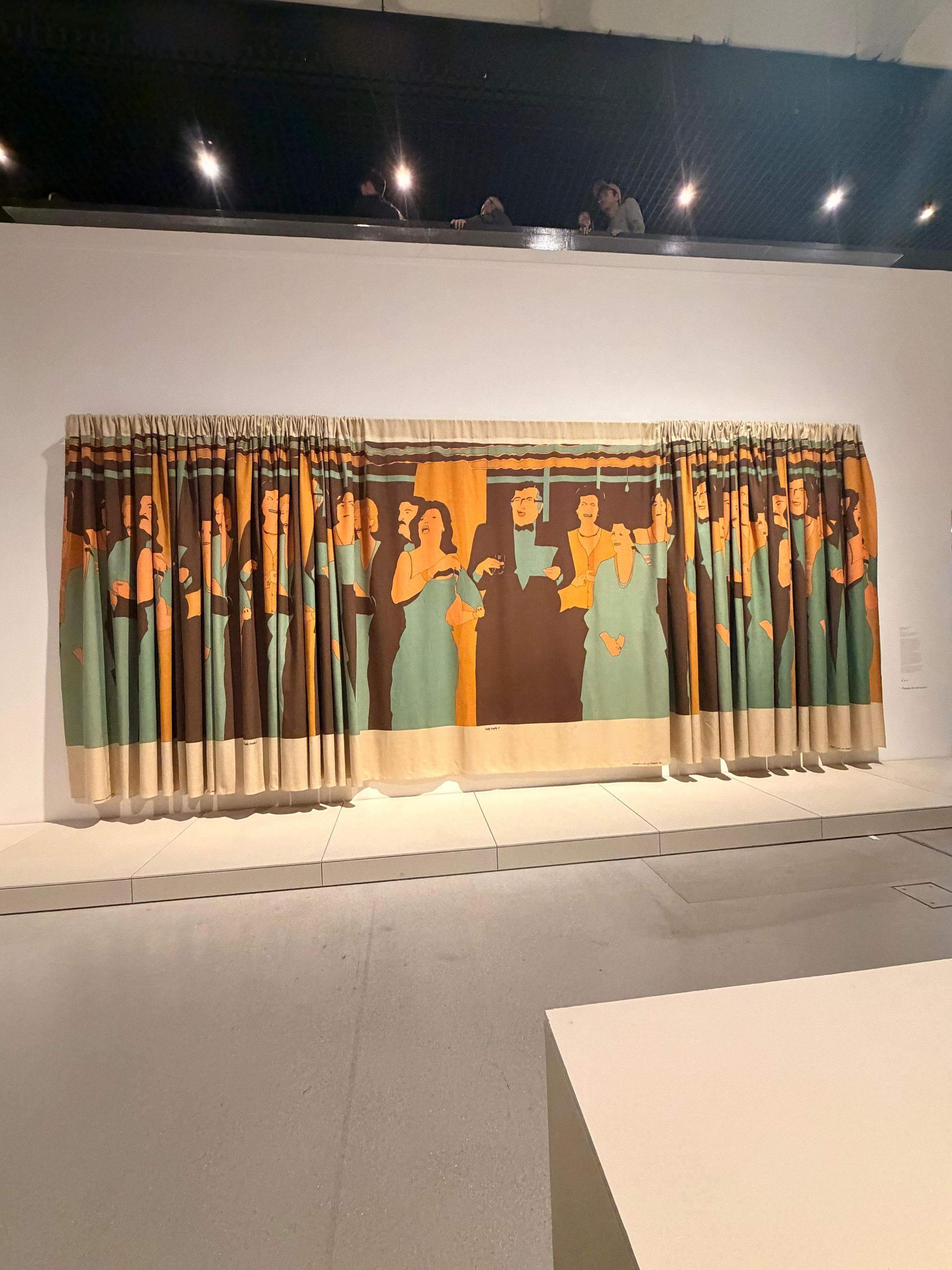
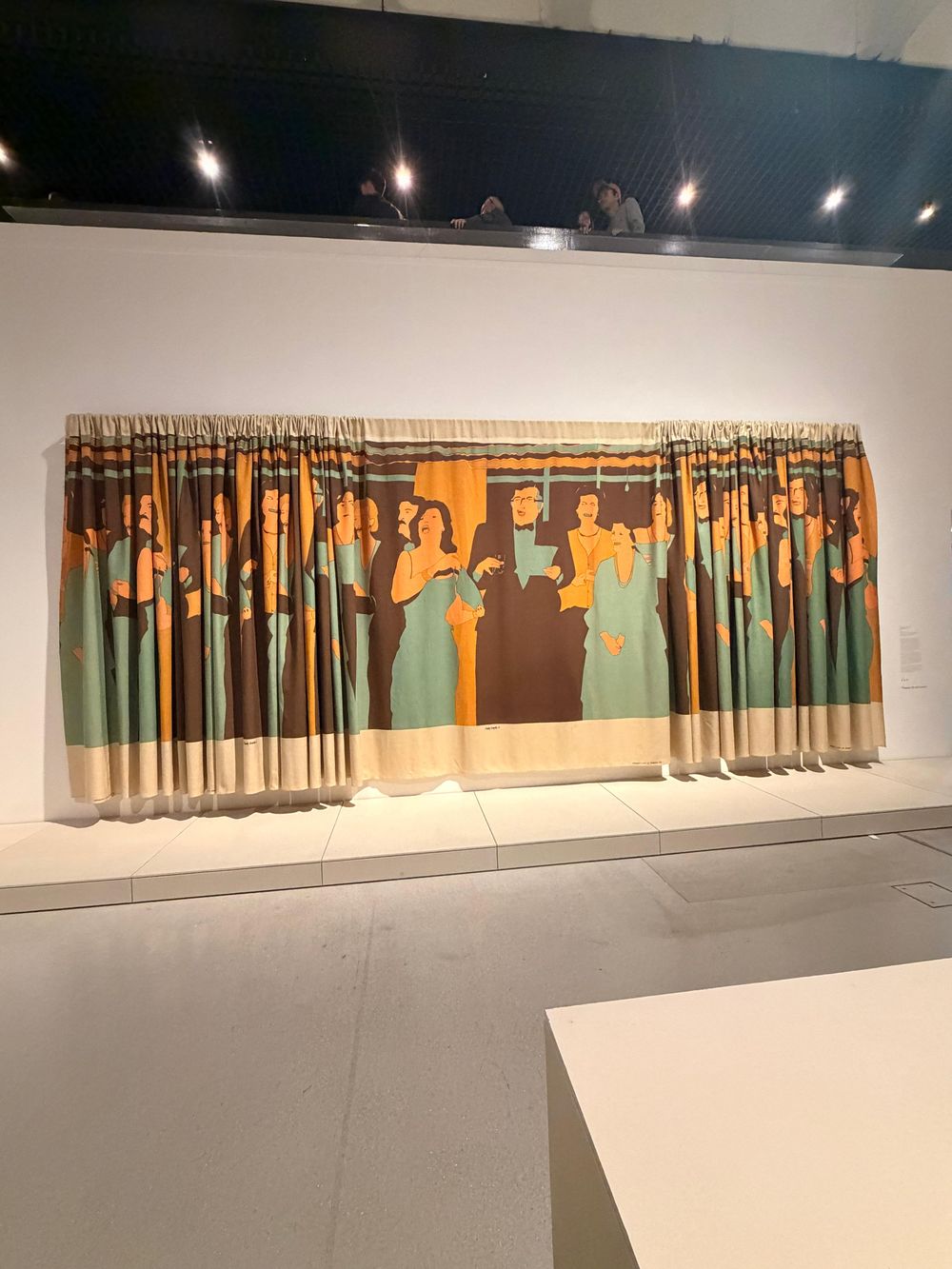
As the exhibition progresses, Gonzalez’s interrogation of systemic violence and political corruption becomes more urgent. In the central atrium we find an abundance of the artist’s sculptural pieces, in which she paints on found objects like dressing tables, bedframes and mirrors in a “kitsch” style. Most impressive is Interior Decoration (1981), a 140m long curtain referencing a newspaper photo from a gala celebrating then president Julio Cesar Turbar Ayala. The scale of the piece is grand, the use of curtain reading as a tapestry that at first it may seem to lean into the splendor of the occasion. However, there is something unnerving about the figures, with their sardonic smiles and awkward poses. Gonzalez clearly isn’t looking to flatter them. Turbar Ayala built a cult of personality at a time of increasing political unrest and conflict. In this way, Gonzalez cleverly uses the curtain as a symbol of concealment, an attempt to cover up entrenched corruption with false smiles and parties.
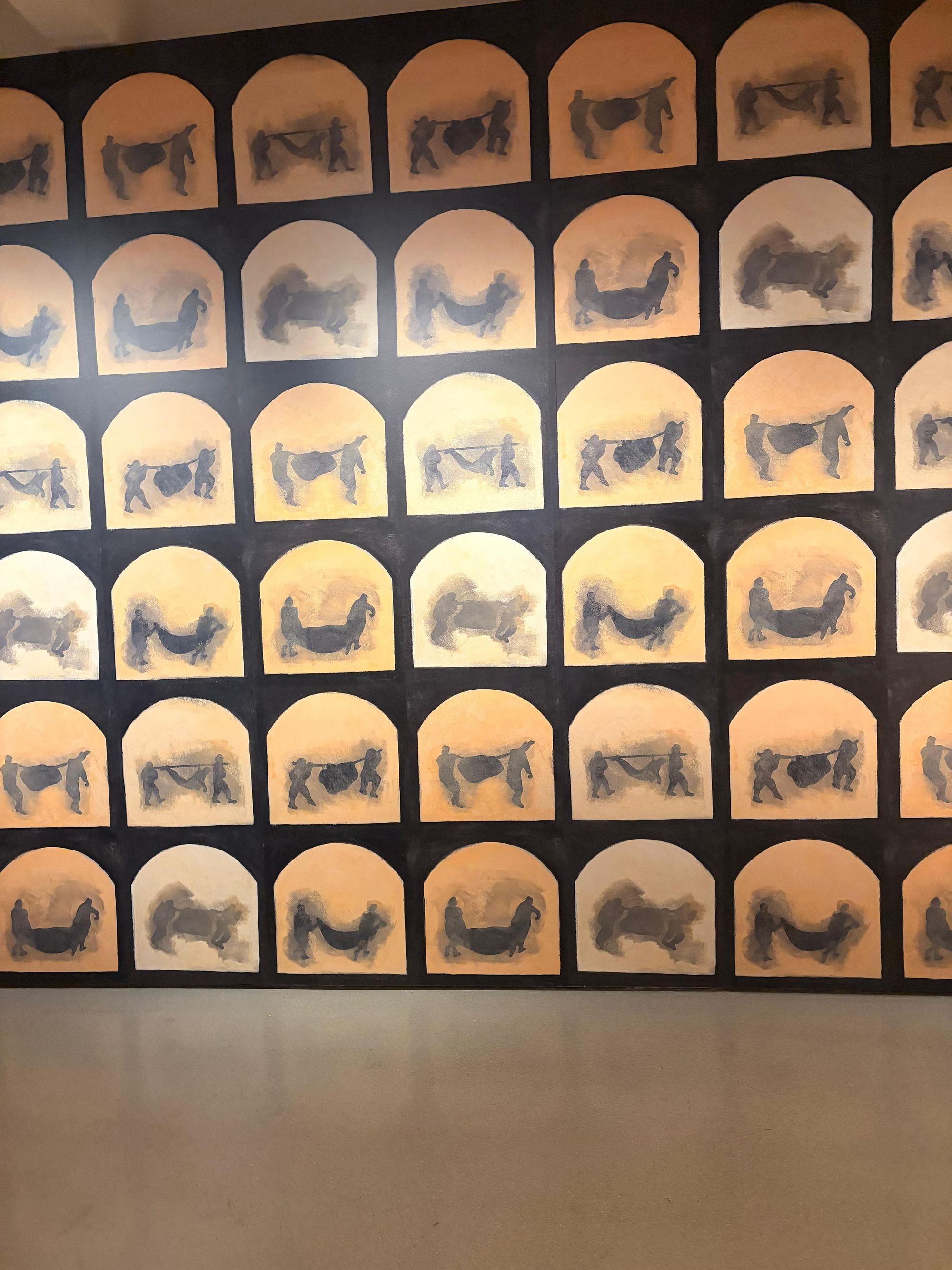
Moving from the monumentality of the atrium to the final room of the exhibition, the mood becomes much more sombre in Gonzalez’s most recent and final work. We are confronted with an installation, titled A Posteriori (2022), in which screenprints of graves span the walls, one on top of the other. The colour is gone, the room is quiet. In 2003, several buildings at Bogota Central Cemetery were demolished, which had housed hundreds of victims of conflict in Columbia. The installation serves as a mausoleum, a space in which people can reflect, mourn and pay their respects to the dead.
Time and time again, we see how unreserved Gonzalez was in giving grace to the marginalised. Bearing witness to the horrors committed by the State in monumental murals to tiny painted objects, she gives them a voice. As I left the exhibition to cast my vote, I felt a greater appreciation for the collective responsibility we have for each other: to stand up for the victims of injustice broadcasted across the media, and more importantly those who are not.
By Eleanor Getting